
This is an introductory article that introduces AWS.
AWS - Amazon Web Services
Before we get into AWS, we need to know a thing related to cloud computing.
If you are familiar with cloud computing, then you may know cloud service models.
There are three types of cloud service models:1. IaaS (Infrastructure as a Service)2. PaaS (Platform as a Service)3. SaaS (Software as a Service)

Now, we know the types of models in cloud computing. Then let's begin with AWS.
AWS is the most well-known cloud provider in the world. Its competitors are Microsoft Azure, GCP (Google Cloud Platform), Alibaba cloud, and so on.
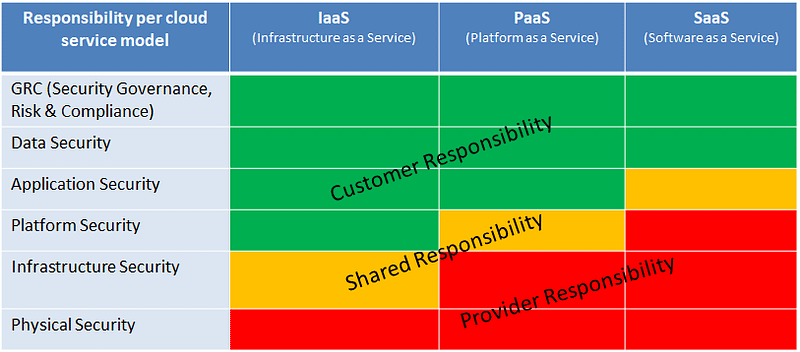
AWS is an Infrastructure as a Service + Shared Responsibility Model.

In the below picture, you can see where AWS stands. With the help of this, we can understand that we have a shared responsibility in Infrastructure security. Cloud providers are handling physical security. We will manage the rest.
AWS is offering 200+ universally featured services, from infrastructure to machine learning.
List of few services are:
- Amazon EC2 (Elastic Compute Cloud)
- Amazon RDS (Relational Database Service)
- Amazon S3 (Simple Storage Service)
- Amazon Lambda
- Amazon CloudFront
- Amazon VPC (Virtual Private Cloud)
- Amazon SQS (Simple Queue Service)
- Amazon Elastic Beanstalk, and so on.
We will discuss those services briefly in the upcoming articles.
Advantages of AWS
- User-friendly interface.
- Resource creation is fast.
- Cost-effective.
- Reliable.
- Scalable.
- Secure.
- Flexible.
Disadvantages of AWS
- Limitations on resources.
- Price variations.
- Confusing Billing page.