
To know the role of an operating system (OS) we need to know the basic hardware of a computer system. A computer system consist of a Central Processing Unit (CPU), Random Access main memory (RAM), Secondary storage, typically in the form of a disk, and input/output (I/O) devices.

Programmers and casual users need to think in terms of high-level operations executed on complex data structures. Casual users wish to be even more remote from computer hardware and only interact with the system using high-level commands or graphics interfaces.
The operating system (OS) is the software that runs on the bare hardware of a computer and provides essential support for users to develop and use applications in the most efficient and safe manner.
The OS as an extended machine
Operating systems (OSs) simplify complex hardware into a more user-friendly form.
They achieve this through two primary techniques:
- Abstraction: OSs group low-level hardware operations into higher-level, easier-to-understand tasks. This simplifies programming and reduces the need to understand intricate hardware details.
- Virtualization: OSs create the illusion of multiple, independent machines or resources, even if the underlying hardware is limited. This allows multiple applications to run simultaneously without interfering with each other. OSs rely on virtualization to create virtual CPUs, memory, I/O devices, and other system components that facilitate the work of programmers and users.

The OS as a resource manager
Operating systems (OSs) play a crucial role in ensuring efficient computer performance. They manage various computational resources like the CPU, memory, and I/O devices to optimize the execution of multiple applications.
Balancing Resource Utilization
Applications often involve phases of input, computation, and output. To maximize efficiency, OSs strive to keep all resources busy at all times. This involves:
- Sequential Execution: The CPU executes one process at a time, waiting for it to complete its I/O operations before moving on to the next process.
- Multiprogramming: Running multiple programs simultaneously, switching between them when one requires I/O operations.
- Time-sharing (multitasking): Quickly switching between multiple tasks to provide a responsive user experience.
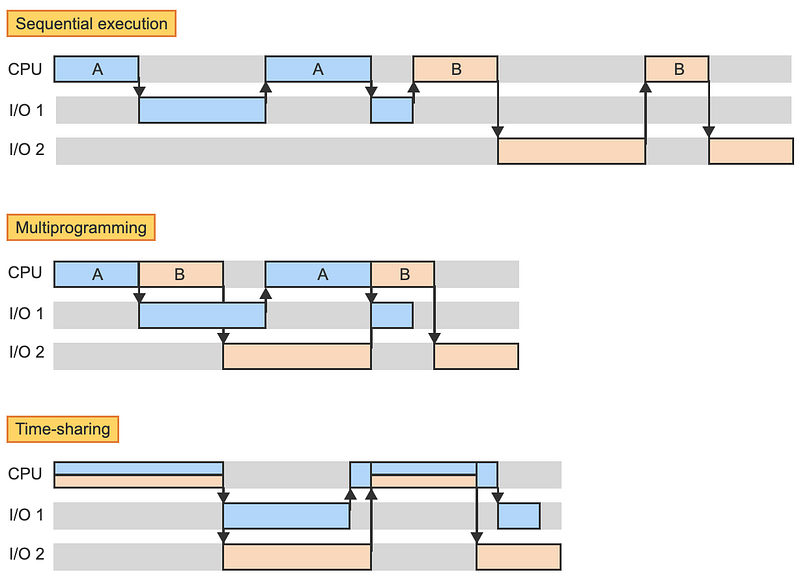
Sequential Execution
- Description: In this scenario, the CPU handles one process at a time.
- CPU: The CPU first executes process A until it needs to perform an I/O operation.
- I/O 1: While process A is performing its I/O operation (shown as a bar in the I/O 1 lane), the CPU remains idle (greyed out area in the CPU lane).
- CPU: After the I/O operation is complete, the CPU resumes executing process A.
- CPU & I/O: This continues until process A completes, then process B begins in a similar manner.
- Result: This approach leads to idle CPU time, as the CPU waits for I/O operations to complete.
Multiprogramming
- Description: Multiprogramming improves CPU utilization by overlapping the execution of multiple processes.
- CPU: When process A is performing an I/O operation, instead of keeping the CPU idle, the CPU starts executing process B.
- I/O 1 & I/O 2: As processes A and B perform I/O operations (in I/O 1 and I/O 2 lanes), the CPU switches between them based on their needs.
- Result: This approach reduces idle CPU time, making better use of CPU resources.
Time-sharing
- Description: Time-sharing is an extension of multiprogramming where the CPU rapidly switches between processes, giving the illusion that processes are running simultaneously.
- CPU: The CPU time is divided into small time slices, and each process is given a turn to use the CPU within each time slice.
- CPU Switches: The CPU switches between processes A and B more frequently than in multiprogramming.
- I/O 1 & I/O 2: I/O operations are handled similarly, but the frequent switching ensures that no process monopolizes the CPU.
- Result: This technique allows for a more responsive system, especially in interactive environments, by ensuring that all processes get regular access to the CPU.
Hence, the operating system serves as both an extended machine and a resource manager, simplifying complex hardware interactions and optimizing resource utilization through techniques like multiprogramming and time-sharing. This ensures efficient and responsive execution of applications, enhancing the overall user experience.